

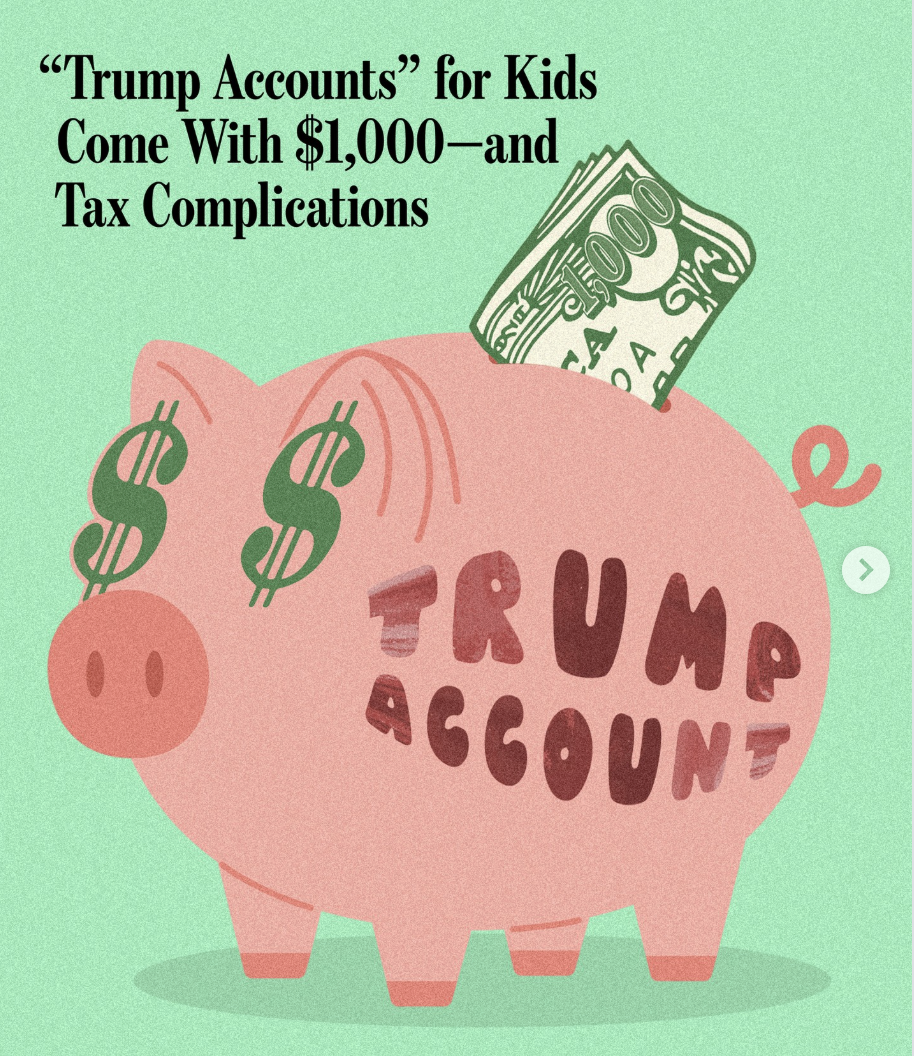
Trump Accounts vs. Custodial Accounts: What Parents Actually Need to Know
Edited by Akiva Goodman, Registered Investment Advisor, The Nestegg Group
With Trump Accounts (Section 530A accounts) launching in 2026, parents are asking:
Should I open one for my kids?
The short answer: Probably not, unless you’re getting free money.
What Are Trump Accounts?
Trump Accounts are a new type of IRA designed for kids under 18. Parents can contribute up to $5,000 per year, and kids born between January 1, 2025 and December 31, 2028 get a $1,000 government contribution. The funds are completely locked until age 18, you can only invest in index funds, and contributions start July 4, 2026.
Sounds great, right? Not so fast.
The Better Option: Custodial Accounts
For most families, there’s a simpler solution that’s been working for decades: Custodial Accounts (UGMA/UTMA). These are straightforward investment accounts you control for your child. There are no contribution limits, you can invest in anything you want, and you can access funds anytime for the child’s benefit. Most importantly, they generally offer much better tax treatment.
The Tax Trap Nobody’s Talking About
Here’s where Trump Accounts fall apart. When your child withdraws money at age 18, all the growth gets taxed as ordinary income. That means they’ll pay 10% to 22% in taxes on every dollar of profit.
Compare that to a Custodial Account, where withdrawals are taxed as long-term capital gains. For most 18-year-olds with little other income, that rate is 0%. Yes, zero percent.
Let’s look at real numbers. Imagine your child’s account grows to $50,000 by age 18. You contributed $20,000 and it grew $30,000.
With a Trump Account, your child pays $3,600 to $6,600 in taxes on that growth. With a Custodial Account, they pay $0.
That’s thousands of dollars staying with your child instead of going to the IRS.
The “Tax-Deferred” Benefit Is Overrated
Supporters of Trump Accounts talk about tax-deferred growth. But here’s what they don’t tell you: Custodial Accounts are essentially tax-deferred too for most families.
The first $2,700 or so of a child’s investment income each year is essentially tax-free or taxed at very low rates. To exceed that threshold, you’d need over $150,000 in a (tax-efficient (ETF) account. Most families never hit those limits, thus the custodial account too is essentially tax-deferred
Flexibility Actually Matters
Life doesn’t follow a script. What if your child needs money at 17 for a business opportunity? What if they need a reliable car at 16 to get to work?
Trump Accounts are completely locked until January 1st of the year they turn 18. No exceptions. Plus, you can only invest in index funds, nothing else.
Custodial Accounts give you complete control. You can use the money anytime for anything that benefits your child, with no penalties or restrictions. And you can invest in individual stocks, international funds, bonds, cryptocurrency, or anything else you think makes sense.
When Trump Accounts Actually Make Sense
We’re not saying Trump Accounts are always bad. There are three situations where they work:
First, if your child was born between 2025 and 2028, grab that free $1,000 government contribution. Open the account, take the money, and let it grow. You can still use a Custodial Account for your own contributions.
Second, if your employer offers matching contributions to Trump Accounts (like they might with a 401(k)), take the free money.
Third, if you’re already maxing out 529 plans, your retirement accounts, and Custodial Accounts and still want to save more, a Trump Account could be an extra option. But this applies to very few families.
For everyone else contributing their own money without free matches, Custodial Accounts are the clear winner.
The Simple Truth
The financial industry loves creating complex new products. Sometimes they’re genuinely helpful. Often, they’re just solving problems that don’t exist.
Trump Accounts fall into that second category for most families. They come with higher taxes when your child actually needs the money, they’re completely locked until age 18, and they restrict your investment choices to index funds only.
Meanwhile, Custodial Accounts have been quietly working for decades, offering better tax treatment, complete flexibility, and no gimmicks.
Here’s the simple rule: Get the free $1,000 if your child qualifies. For your own money, use a Custodial Account. It’s more tax-efficient and gives your child more options when they actually need it.
What You Should Do Now
Need help setting up a Custodial Account?
- Living Smarter Jewish: Financial education and resources for Jewish families
- RSK: Financial guidance and support services
Struggling with debt?
- Kosher Debt Help: Honest, expert guidance with no hidden costs or obligations
Don’t let marketing hype distract you from what actually works. Your kids deserve a strategy that maximizes their money, not the government’s tax revenue. Save smart, save simple, and give your children the financial head start they deserve.